Session 1.1.1 – Introduction
Welcome
We are pleased to welcome you to this elective. Over the coming weeks, you will explore how artificial intelligence and data science are transforming healthcare delivery, decision-making, and patient care. This course is designed to help you develop a practical understanding of AI tools and their real-world applications in clinical settings. Whether you are completely new to these concepts or bring some prior experience, we look forward to learning together as we examine how these technologies work in practice, not just in theory. We are excited to have you here and look forward to the discussions and insights you will bring to our sessions.
This session is designed to introduce the people in the room and remotely joining the class.
Student Introductions and Icebreaker Activity
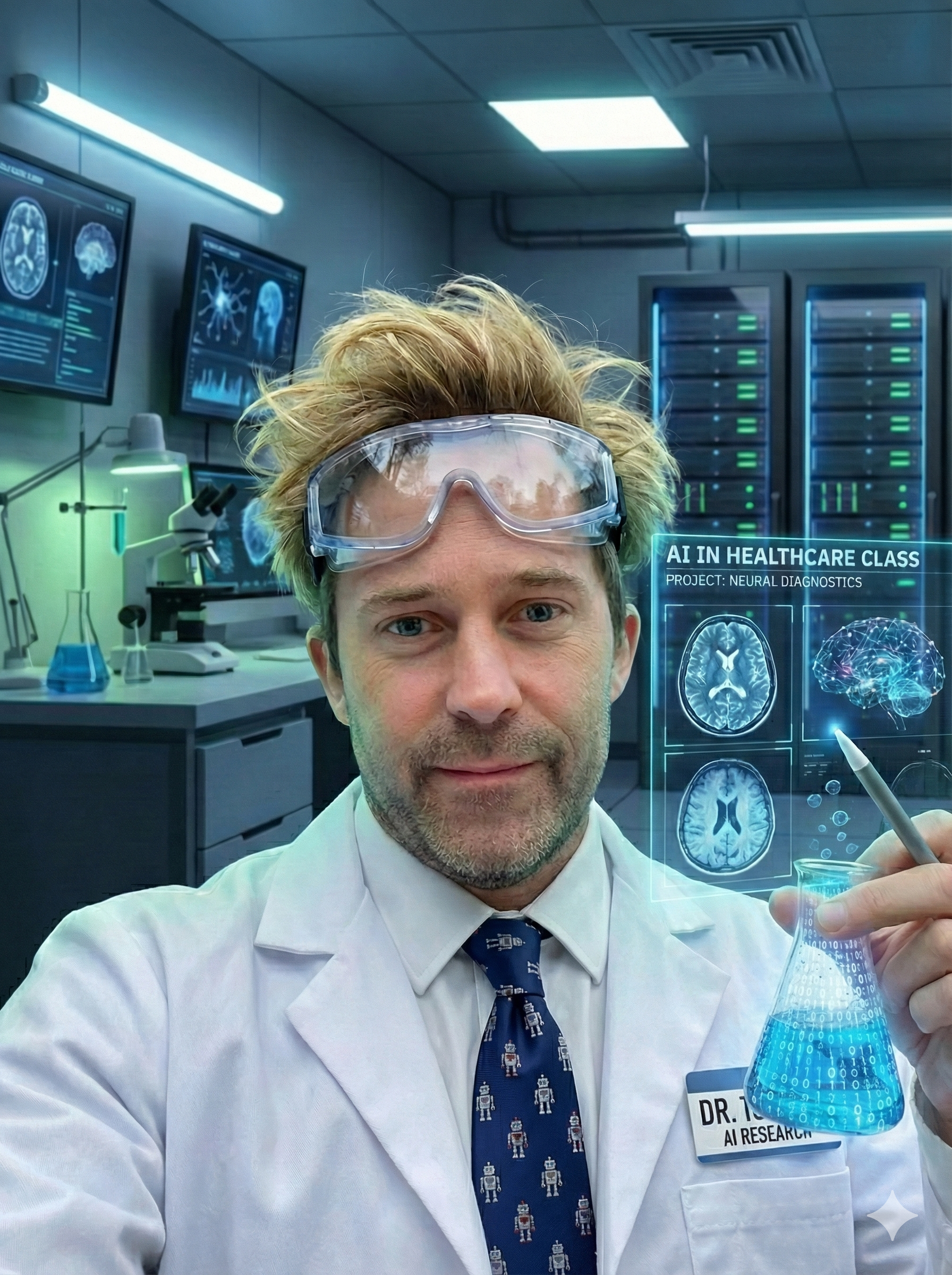
Self-Portrait
Use any generative AI tool to create a self-portrait that represents how you see yourself.
This can be literal or abstract. You might highlight your interests, hobbies, future specialty, or any other elements you feel shape your professional or personal identity. The goal is simply self-expression and reflection.
Introductions
Introduce yourself, including:
- Name
- Specialty
- Experience with AI (if any)
- Show your self-portrait and reflect on:
- What aspects felt accurate?
- What felt generic or off-target?
- What surprised you?
Instructors
Thomas Hartka, MD, MS, MSDS

"I see AI in healthcare as both overhyped and underhyped, overpromising in the short term while accelerating innovation that will drive long-term changes difficult to imagine today. It is an extraordinary time to be practicing medicine and to have the opportunity to witness these transformations firsthand. I suspect that much of the care we provide today will one day seem more akin to leeches and bloodletting compared with what will be possible twenty years from now."
Andrew Taylor, MD
"AI should be treated less like an oracle and more like clinical infrastructure: invisible when it works, auditable when it doesn't, and always accountable to the patient it ultimately serves."